
Last updated October 16, 2026
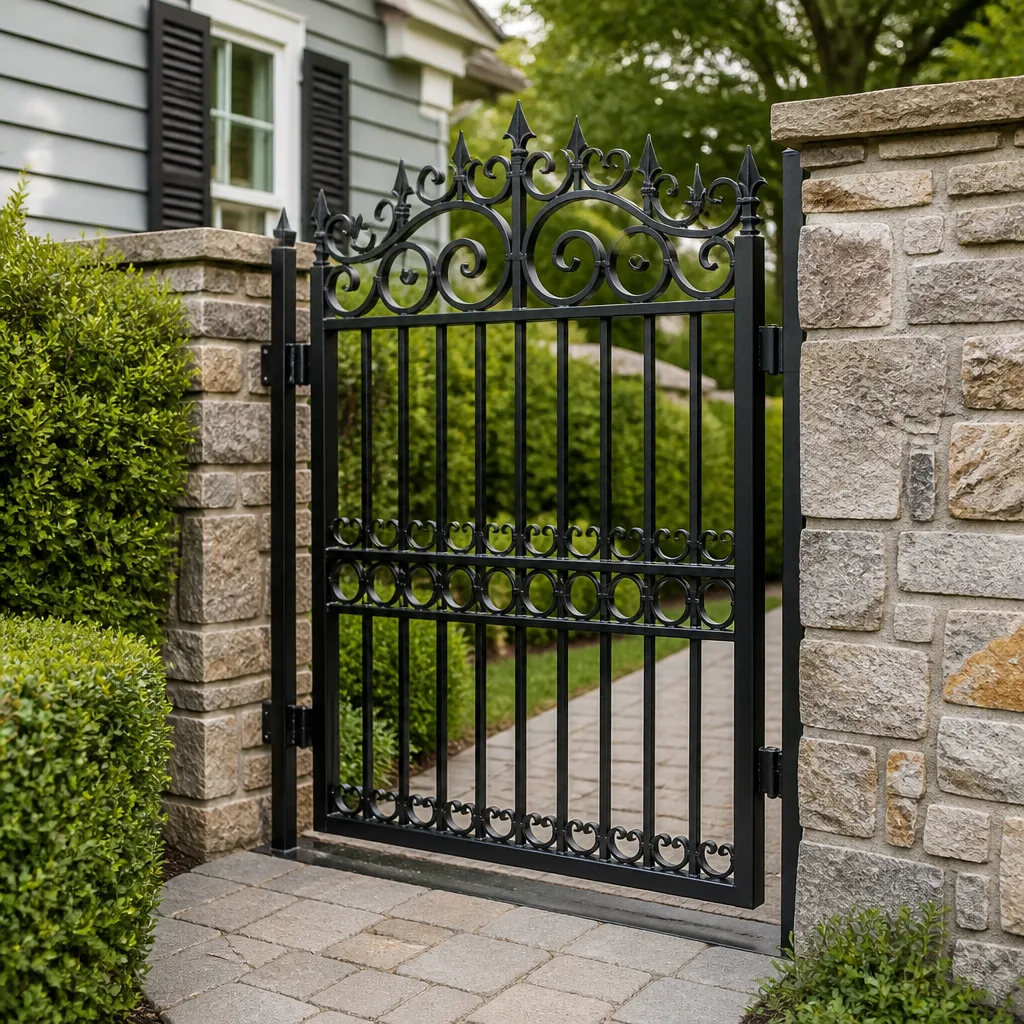 Wrought iron
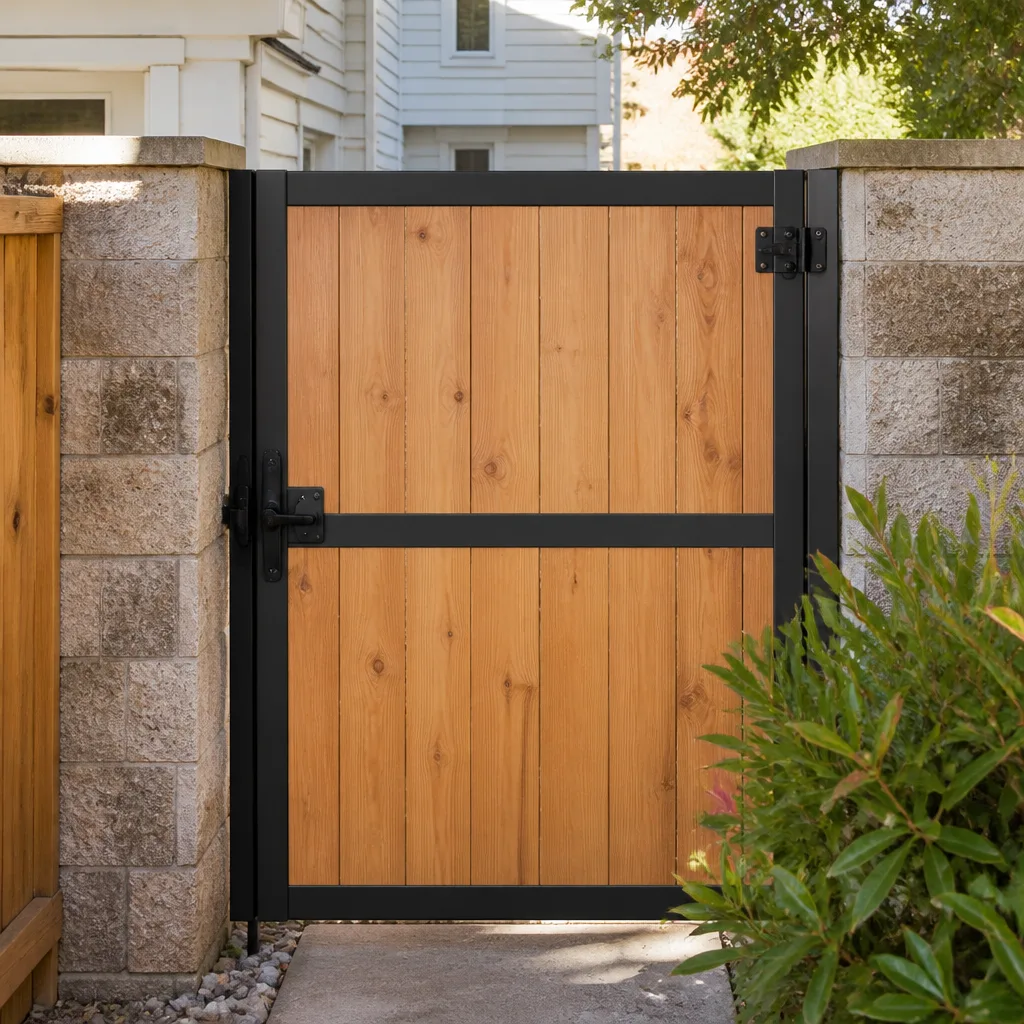 Wood & steel frame
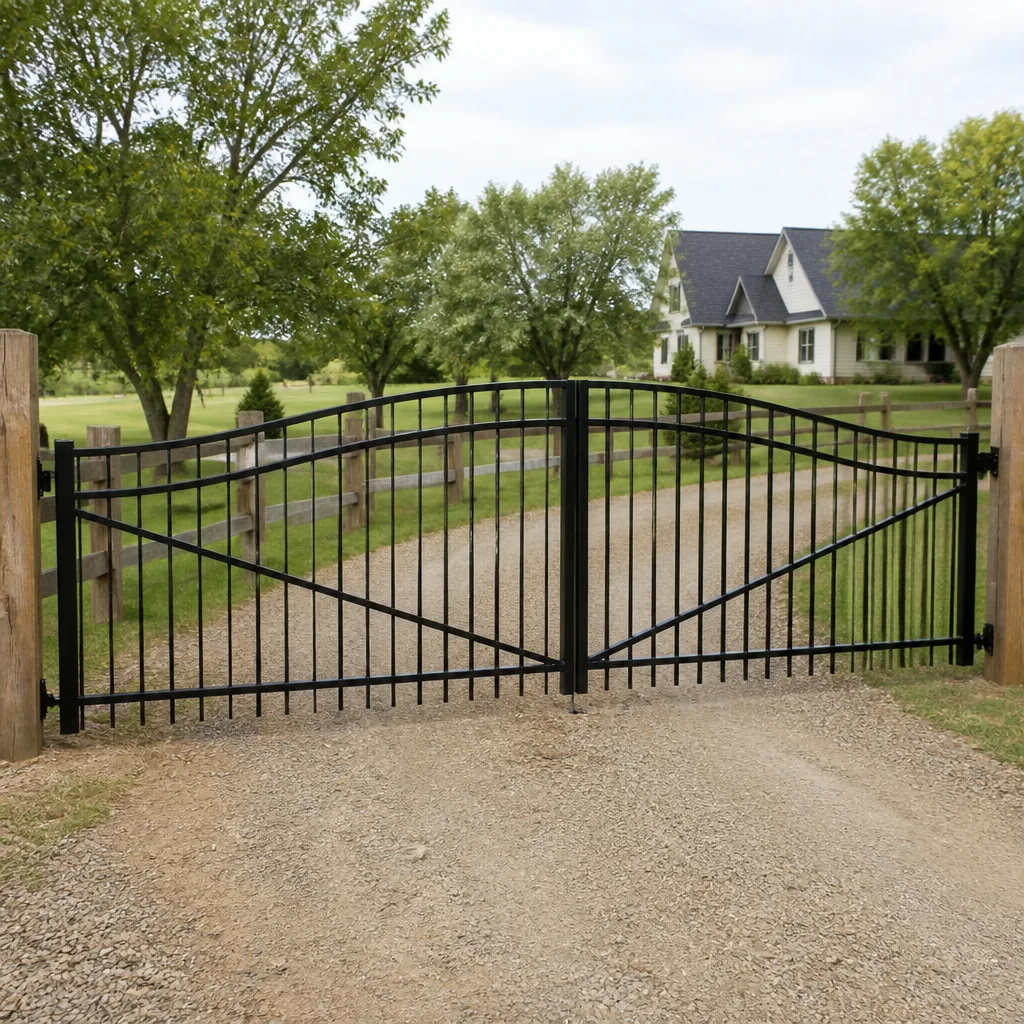 Farm & ranch
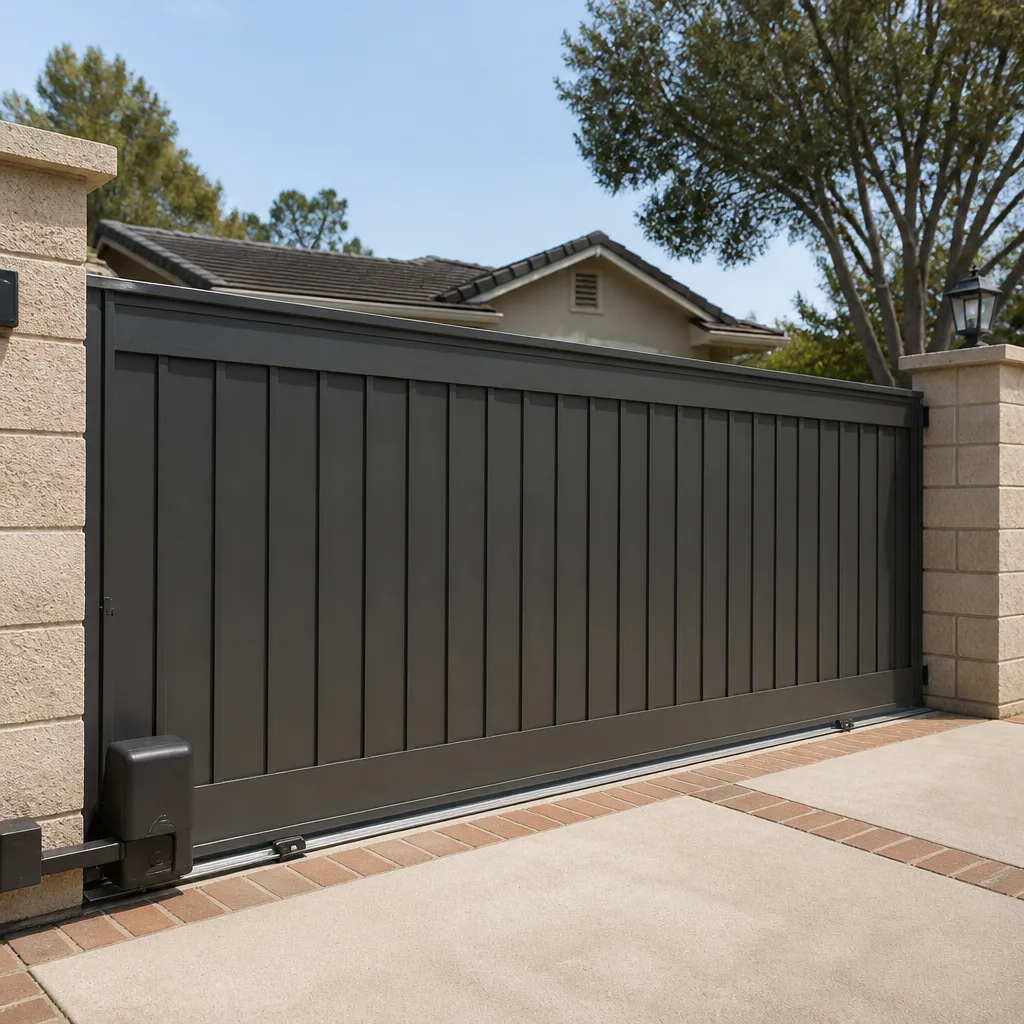 Sliding driveway gates
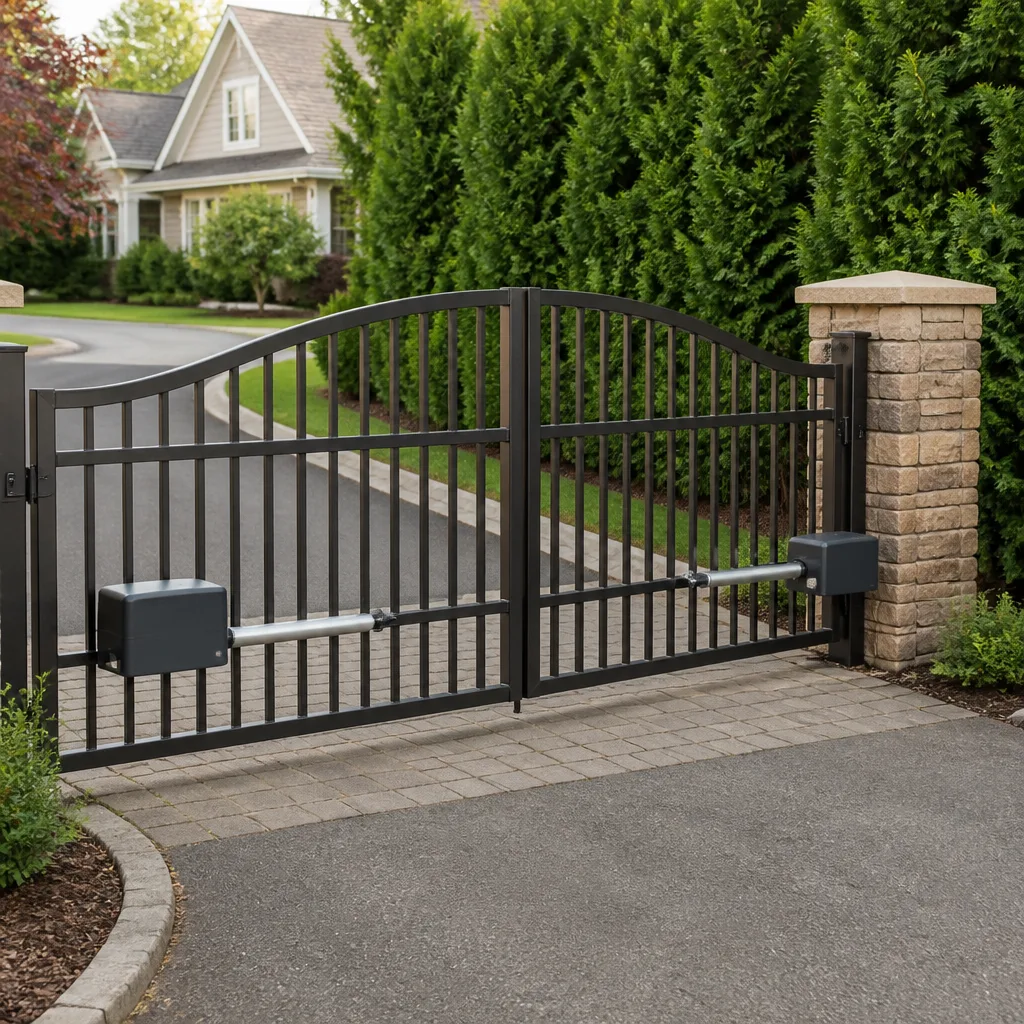 LiftMaster operators
Free on-site gate assessment - hinges, posts, and your LiftMaster or Nice gate operator checked before anything is quoted
The assessment is free and the quote is the invoice.
Get your free estimateThe Complete Guide to Gate Repair in Miami
A wrought-iron gate in coastal Miami sees more corrosive salt exposure in one year than the same gate in Atlanta sees in a decade. Yet most gate repair guides treat rust as a single, simple problem. It’s not. In Miami, a gate fails differently than it does in Orlando, Tampa, or anywhere else in the country. This guide walks you through the specific failure patterns we see across Miami neighborhoods, what they cost to fix, and when a repair is genuinely urgent versus when it can wait a week; for a deeper comparison, see our DIY vs Professional Gate Repair: The Miami Homeowner’s Decision Guide. You’ll finish this page knowing more about your gate than most people who sell them.
Quick Answer
Gate repair in Miami typically costs between $165 and $1,900 depending on the failure. Minor fixes like hinge adjustments and limit-switch recalibration run $165 to $350, while actuator or operator replacement on an electric gate commonly runs $700 to $1,900 parts and labor. Most issues we see are caused by Miami’s salt air, high humidity, and clay-heavy soil, and a proper Gate Repair services starts with a written quote before anyone touches a bolt.
Styles & brands we work with
Table of Contents
- How Miami’s Salt Air Actually Attacks Your Gate
- Why Miami’s Clay Soil Causes Post Shift and Hinge Misalignment
- The Components Most Likely to Fail in High Humidity
- Navigating HOA Approval in Miami-Dade Communities
- What Gate Repair Costs in Miami
- Plain-Language Glossary: Terms Your Technician Will Use
- Step-by-Step: What a Proper Gate Repair Should Look Like
How Miami’s Salt Air Actually Attacks Your Gate
The Atlantic doesn’t need to touch your gate to damage it. Salt aerosol travels inland for miles, especially during the humid summer months when southeast winds push marine air across Miami-Dade, Coral Gables, Pinecrest, and Kendall. That salt settles on metal and begins a slow electrochemical reaction that’s accelerated by heat and moisture. It’s a compounding problem: warm air holds more salt, and humid air keeps it wet, which keeps the reaction active.
Here’s what matters for your gate:
- Wrought iron corrodes from the inside out when the protective paint layer gets a hairline crack. You’ll see bubbling paint first, then rust staining, then flaking metal. By the time you see rust on the surface, the damage underneath is already worse.
- Aluminum doesn’t rust like iron, but it does oxidize. You’ll see a dull white powder or pitting, especially on gate frames near the bottom hinge, which is the first place saltwater pools and dries.
- Steel gates, often used for sliding driveway models, corrode fastest at weld points and along the bottom track, where salt concentrates and never fully rinses away.
What we see in practice: a gate five blocks from Biscayne Bay in the Upper East Side will show visible corrosion within 18 to 24 months of a fresh paint job. The same gate in inland Doral or Hialeah might go four to five years before the first bubble appears. In our experience at Portcullis Gate Repair Miami, the fix isn’t just repainting; it’s removing the corrosion, treating the metal with a rust converter, priming, and then repainting with a marine-grade coating. Anything less and you’re doing it again in two years. We cover the details of that process in our guide to gate repair in Miami.
Why Miami’s Clay and Limestone Soil Causes Post Shift
Most of Miami-Dade sits on a mix of porous limestone and clay-heavy marl. When it rains, the soil expands. When it dries, it contracts. Over a dry-wet cycle repeated hundreds of times, the ground moves enough to shift gate posts by a quarter inch or more. That doesn’t sound like much, but a quarter inch at the post translates to an inch or more of sag at the latch end of a ten-foot gate. Your gate starts dragging. The latch misses the strike. The hinges bind and wear unevenly.
This is one of the most common calls we field in neighborhoods like Kendall, Westchester, and Cutler Bay, where the clay content is high and the rainy season is relentless. A gate that worked fine in December starts dragging by March and won’t close by August. The post didn’t fail; the ground under it did.
- What to watch for: a gate that closes fine in the morning but drags after a downpour, or a visible gap between the post and the surrounding concrete.
- What the fix looks like: a proper repair includes re-setting the post in a deeper footing, often with additional concrete and sometimes a steel brace, then re-hanging and re-leveling the gate so the hinges carry the load evenly.
- What makes Miami different: most national repair guides treat sagging gates as a hinge problem. Here, we see it most often as a soil problem. A technician who doesn’t understand that will replace hinges that fail again within a season.
If your gate is sagging and the posts look fine at eye level, the problem is probably below grade. Our page on gate installation in Miami covers what a proper post setting should look like for new gates, which is useful context even for repairs.
The Components Most Likely to Fail in High Humidity
Miami’s average relative humidity hovers around 75 percent year-round and spikes near 90 percent in summer mornings. That constant moisture does specific things to electric gate systems. Here are the components that fail most often in our area, and why they fail here more than anywhere else.
The V-track and guide wheels
Sliding gates run on a V-track, a length of angled steel or aluminum set into the driveway. In Miami’s humidity, debris and organic matter stick to the track and hold moisture against the metal. The track oxidizes, the gate starts grinding, and the guide wheels wear flat on one side. You’ll hear it before you see it: a rumble or grind as the gate moves.
Limit switches
Limit switches tell the operator where the gate should stop. They’re small, they’re mounted near the ground or near the motor, and they’re prone to corrosion in humid air. When a limit switch fails, the gate may slam at the end of travel, stop in the wrong place, or reverse when it shouldn’t.
Photocells and safety edges
Photocells are the small sensors on either side of the gate opening that detect an obstruction and stop the gate from closing on a car, a child, or a pet. In high humidity, the lenses fog, the internal contacts corrode, and the alignment drifts. When a photocell fails, the gate typically refuses to close at all, which is a safety fail-safe but also a serious inconvenience. Safety edges, the pressure-sensitive strips along the gate’s leading edge, also degrade faster in constant moisture.
The control board
The control board is the brain of the operator. Humidity plus salt air is hard on circuit boards. We see more board failures on coastal properties than inland ones, even when the board is in a sealed enclosure. Condensation gets in through conduit openings and works its way down.
None of these are exotic failures. They’re all repairable, and most are repairable same-day if the technician carries the right parts. The difference between a good repair and a repeat visit is diagnosing the humid-environment cause rather than just replacing the part. For more on what we see in Miami’s electric gate systems specifically, our electric gate repair in Miami page walks through common failure modes in detail.
Navigating HOA Approval in Miami-Dade Communities
A lot of Miami residential gates are in communities with a homeowners’ association. Coral Gables, Pinecrest, Key Biscayne, Aventura, and dozens of gated developments across the county have architectural review boards with specific rules about gate style, color, height, and even the type of operator allowed. That adds a layer of process that most gate repair guides completely ignore, and it matters for one reason: it can delay your repair.
Here’s the typical sequence when a gate repair involves any visible change:
- You call a gate company because your gate won’t open or is sagging badly.
- The technician tells you the repair requires replacing a visible component; this could be a gate panel, a post, or in some cases the type of operator.
- Your HOA requires an architectural review application, which can take two to six weeks, depending on the board’s meeting schedule.
- The repair proceeds after written approval.
For this reason, it’s wise to know your HOA’s rules before you’re in an emergency. If your gate fails and the repair is safety-related, most HOAs in Miami-Dade will expedite approval. A gate that won’t close on a pool or a busy street is a liability for the association, not just for you. Our advice: call your HOA manager the same day you call a gate technician. Parallel tracks save time.
One more note on this: HOA rules in Miami often specify a uniform appearance for all gates in a community. If your repair changes the look of the gate, even slightly, you want that documented and approved in writing before the work is done. You don’t want to be the homeowner who gets a violation notice for a gate panel that doesn’t match the rest of the street.
What Gate Repair Costs in Miami
Price is the first question most people ask, and it should be. For a detailed breakdown, see our Gate Repair Cost Breakdown: The Miami Homeowner’s Reference for 2026; here’s what we see in the Miami market for common repairs, based on our own service data and the work we quote weekly across Miami-Dade. These are ranges, not guarantees; your gate and your property are unique.
Common gate repairs in Miami, parts and labor:
- Hinge adjustment or replacement: $165 to $450. If the post is solid and the gate simply needs re-leveling, this is a quick job. If the hinges are seized or the gate is heavy, expect the higher end.
- Limit switch replacement: $180 to $320. This is a component-level repair that often takes under an hour. Brands vary; a Viking or FAAC limit switch assembly may cost more than a generic.
- Photocell replacement or realignment: $150 to $350 per set. The parts aren’t expensive, but diagnosing the alignment and wiring takes time.
- V-track replacement on a sliding gate: $400 to $900 depending on length and whether the old track needs cutting out of the driveway.
- Swing-gate actuator swap: $700 to $1,400. The actuator is the motorized arm that physically pushes the gate open. Most swing-gate actuator swaps run in that range parts and labor, depending on the brand and the gate’s weight.
- Full operator replacement: $1,000 to $1,900. This includes the motor, control board, remote receiver, and often new safety edges. A BFT or Linear operator on a heavy slide gate lands in the upper half of this range.
- Control board replacement: $300 to $650. This fixes the gate’s brain, but a good technician will also check what fried the board in the first place.
Every quote we write at Portcullis Gate Repair Miami is itemized and agreed to in writing before any work starts. That’s not a courtesy; it’s how we operate. If the repair is more than a simple part swap, you’ll see the exact price, the exact parts, and exactly what’s included. No after-the-fact surprises.
Plain-Language Glossary: Terms Your Technician Will Use
A good technician should be able to explain your gate in plain English. But it helps to know the vocabulary before the truck shows up. Here are the terms you’ll actually hear on a driveway in Miami.
- Operator: the motor unit that moves the gate. On a swing gate, it’s usually a box mounted on the post with an arm attached. On a slide gate, it’s a box near the track with a drive gear.
- Actuator: the motorized arm that physically pushes a swing gate open and closed. When someone says “the arm is dead,” they mean the actuator.
- V-track: the angled metal rail set into the driveway that a sliding gate rides on. It’s shaped like a V, and the gate’s guide wheels sit in that groove.
- Limit switch: the device that tells the operator where the gate should stop. When it’s set wrong, the gate slams or stops short.
- Photocell: the small sensor used to detect obstructions in the gate’s path. There’s usually a pair, one on each side of the opening, and they must stay aligned.
- Safety edge: a pressure-sensitive rubber strip along the leading edge of the gate. If the gate touches something, the edge triggers and the gate stops or reverses.
- Keypad: the numeric pad used to enter an access code. Older keypads are a common failure point in humid weather.
- Receiver: the part of the operator that picks up the signal from your remote control. A receiver that was working in January can stop picking up signal after a humid summer.
If a technician starts throwing out terms you don’t recognize, ask for the plain version. A good technician won’t mind. And a good repair starts with a technician who explains what they found, what it costs, and what they’re going to do about it, in that order.
Step-by-Step: What a Proper Gate Repair Should Look Like
Here’s the sequence we follow at Portcullis Gate Repair Miami on every repair call, from phone ringing to gate swinging. This is also a useful checklist if you’re evaluating any gate company.
- You call, a person answers. You describe what the gate is doing, what kind of gate it is, and what brand of operator if you know it. We schedule a visit and give you a real arrival window, not a four-hour block.
- The technician arrives and diagnoses. Before touching anything, we ask what you’ve noticed, when it started, and whether the gate worked fine before. Then we inspect the gate, the operator, the track or hinges, and the power supply.
- You get a written quote. Before a single bolt is turned, you see the price in writing. If the repair involves parts you can’t see, like a buried post, we explain the likely cost and what would change it.
- We do the work. Repairs are done on-site with the parts we carry or can get quickly. We clean up after ourselves. That’s part of how we run every job, not an add-on.
- You get the guarantee in writing. Every repair carries the Kingswell Guarantee, written on the invoice. If the repair fails within 365 days, we come back and fix it at no charge under the 365-Day Done Right Promise.
That last step matters more than the first four combined. A repair that fails two months later isn’t a repair; it’s a rental. The written guarantee is the only thing that separates a real fix from a temporary one.
Common Mistakes to Avoid
- Painting over rust without treating it. In Miami’s humidity, rust comes back through the new paint within a year unless the metal is cleaned, treated, and primed first. You’re not saving money; you’re deferring a more expensive repair.
- Assuming the gate is the problem when the ground is. If your gate sags or drags after a rainy week, the post has likely shifted in Miami’s expansive clay. Replacing hinges without addressing the footing guarantees a repeat failure.
- Waiting on a grinding noise. A grinding V-track or a binding hinge doesn’t fix itself. The longer it runs, the more the worn parts damage the parts around them, and the repair gets bigger.
- Ignoring a gate that stops mid-travel. When a gate stops and reverses for no apparent reason, it’s usually a photocell or safety edge. That’s a safety system doing its job. Don’t disable or bypass it; fix it.
- Hiring a technician who won’t put the price in writing first. In Miami, where the gate trade has plenty of one-truck operations that disappear, a verbal quote is worthless. If it’s not written down, it doesn’t count.
- Skipping HOA approval on a visible change. A new gate panel or a different operator style can trigger a violation notice months later. Get the approval in writing before the work starts.
- Assuming salt air only matters if you live on the water. Salt aerosol carries miles inland. If you’re east of the Palmetto Expressway, your gate sees meaningful salt exposure. If you’re east of US-1, it’s severe.
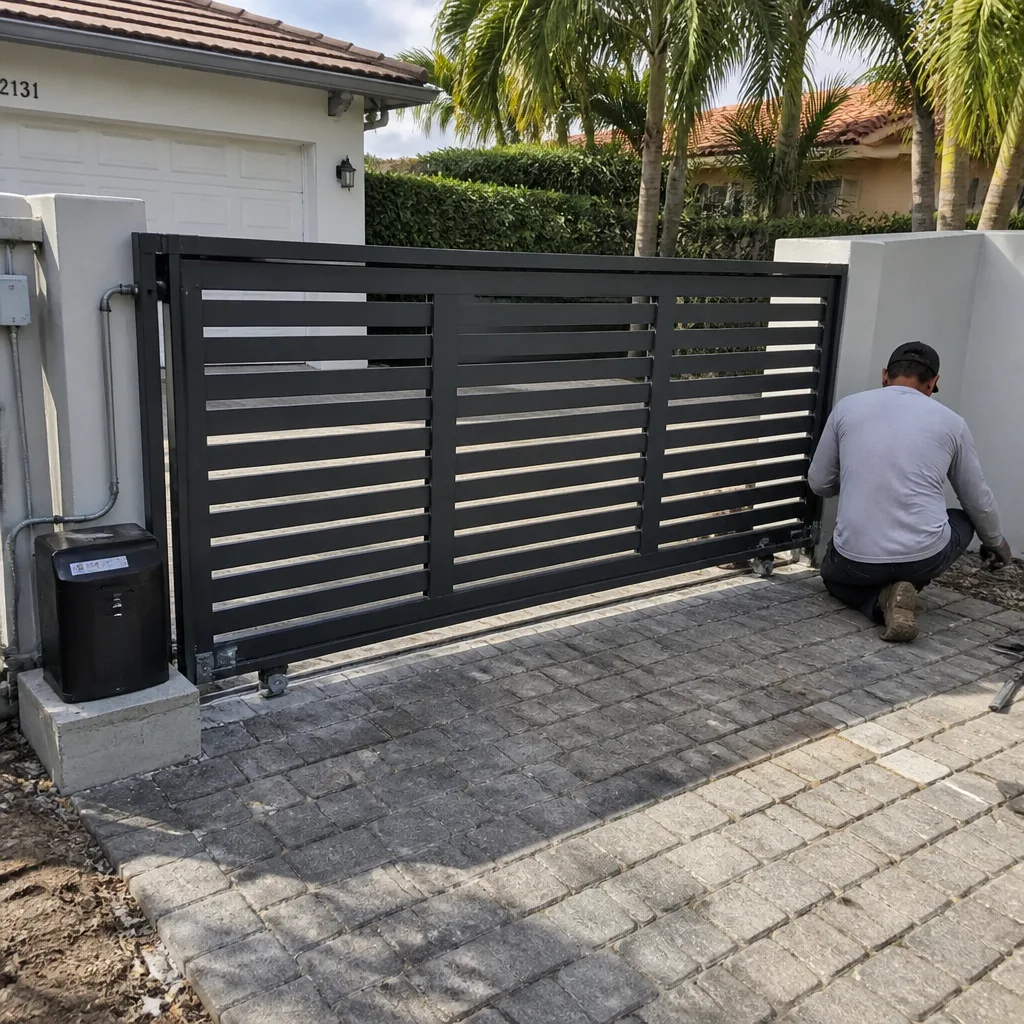
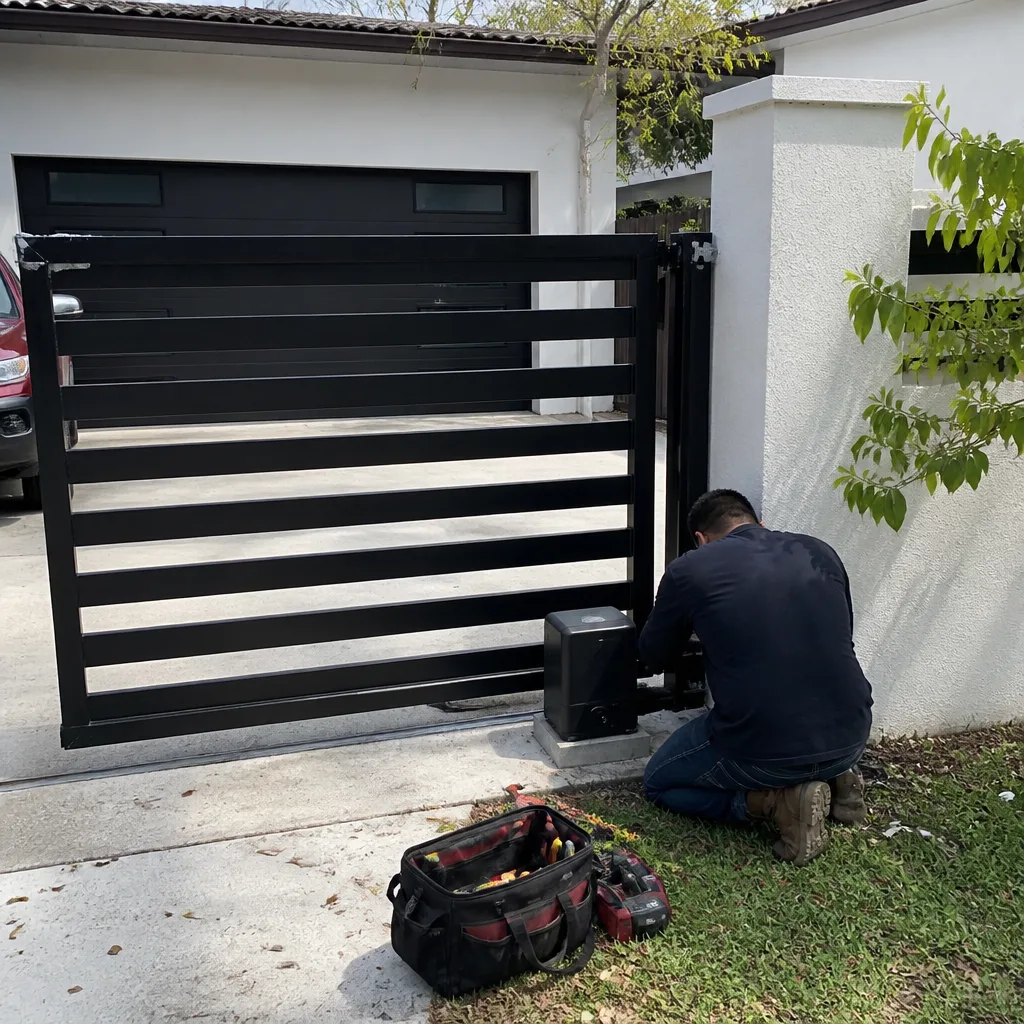
See the difference
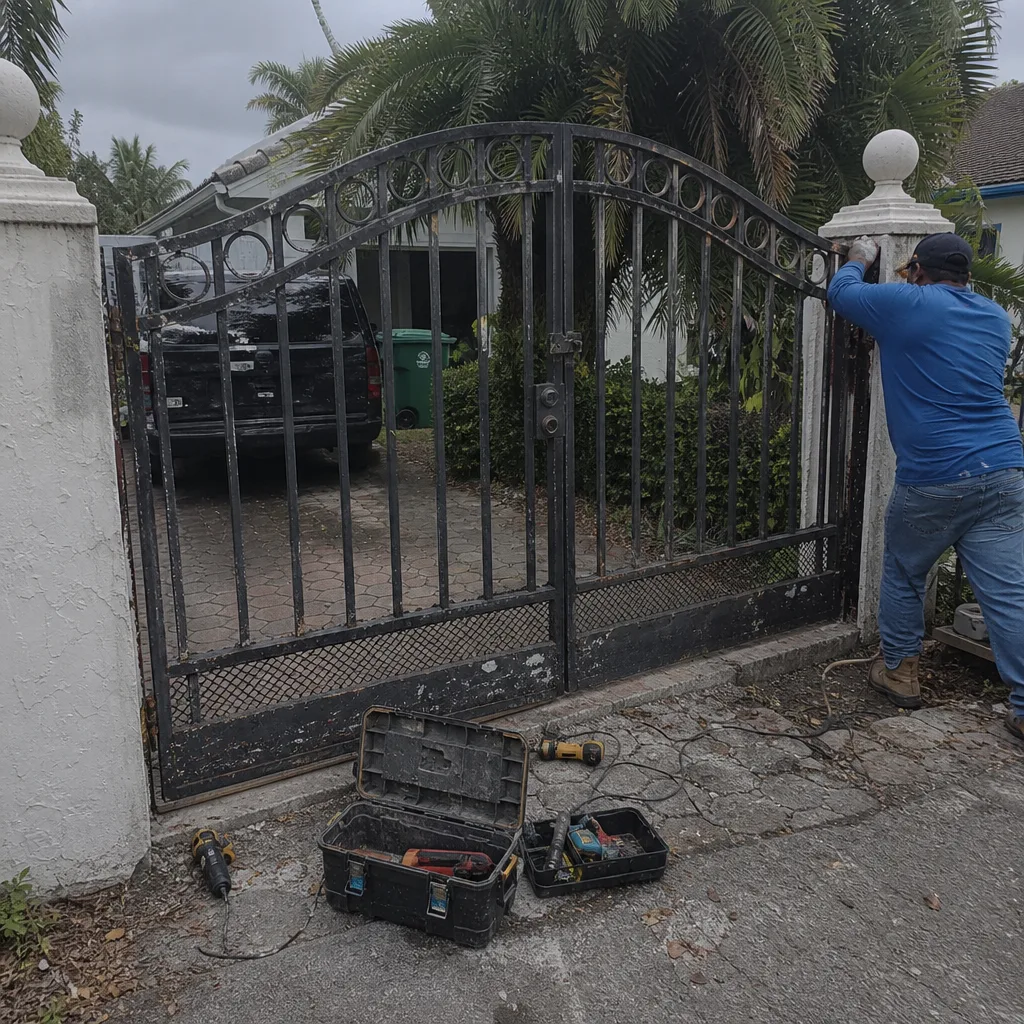 Before
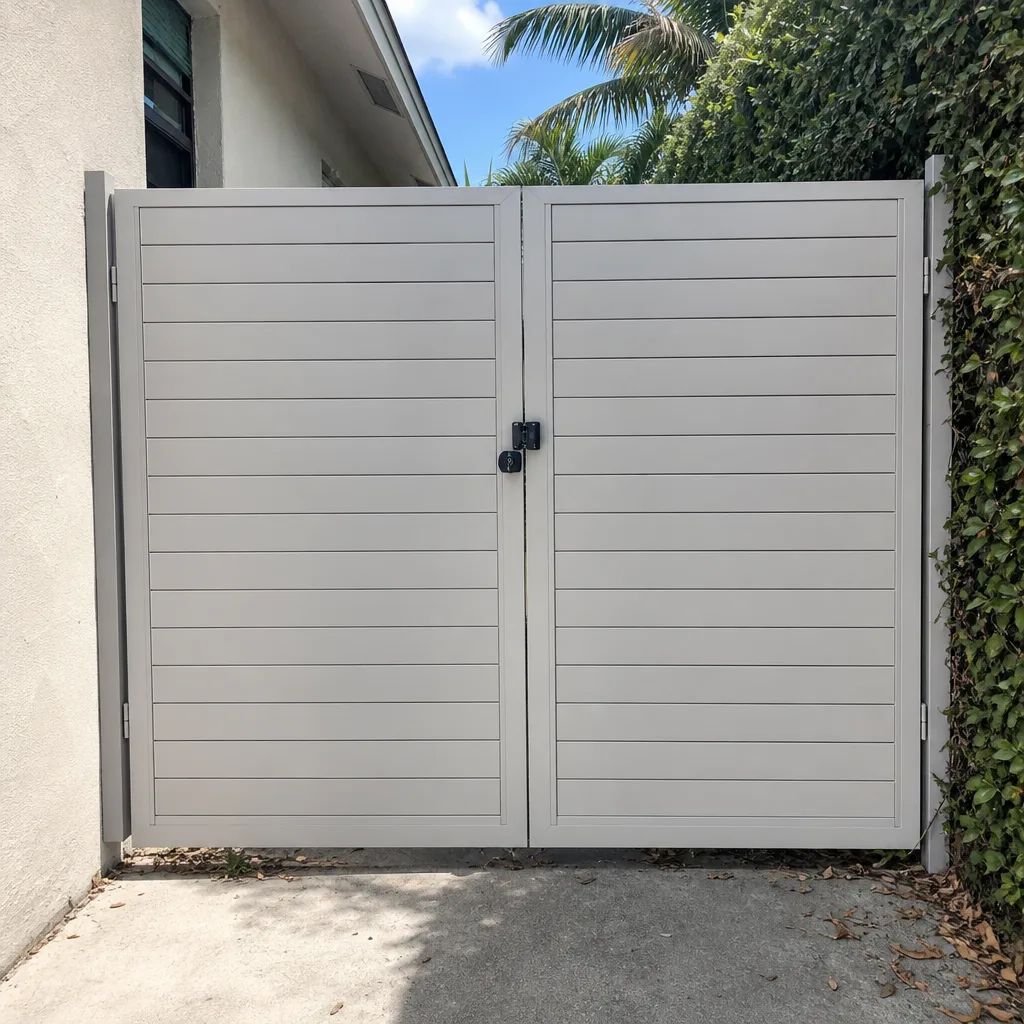 After
After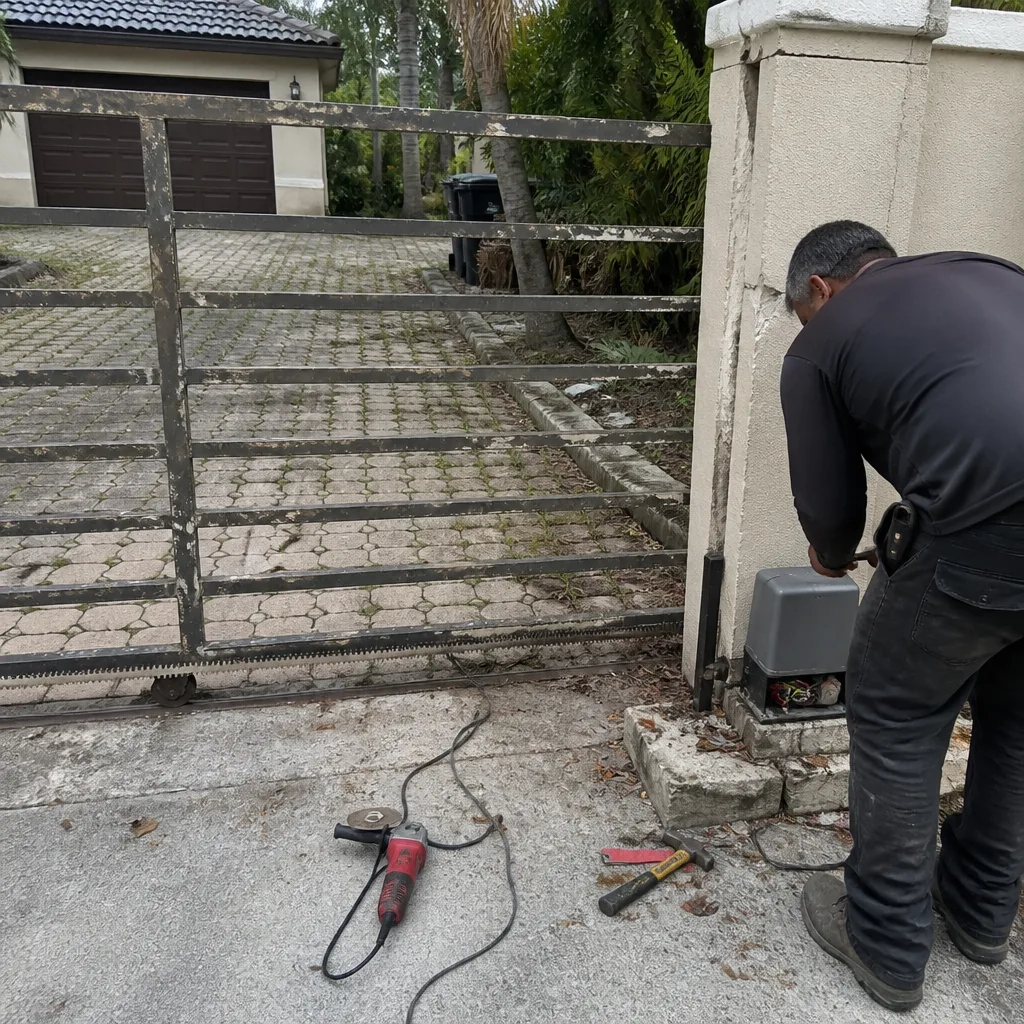 Before
 After
After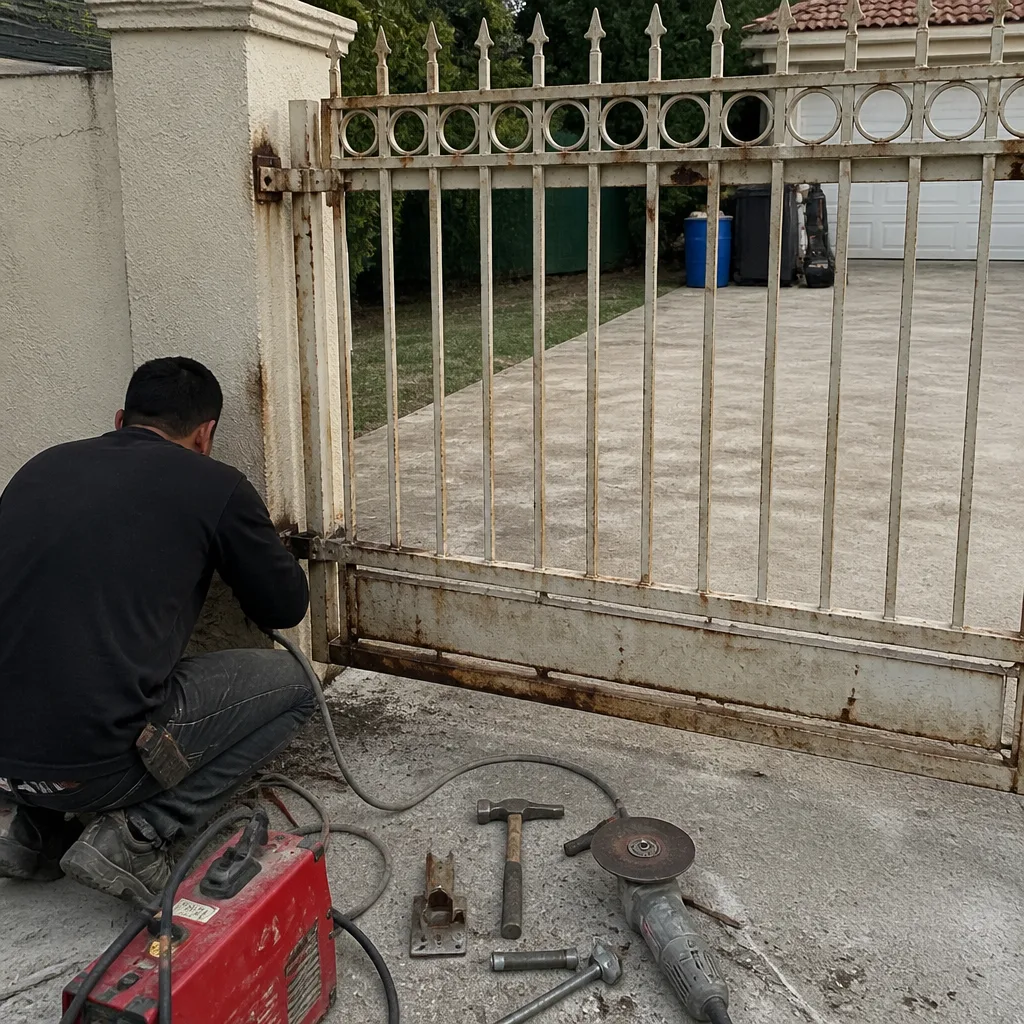 Before
 After
AfterWhen to Call a Professional
You should call a gate professional when the gate won’t open or close reliably, when it makes sounds it didn’t make before, or when it has visibly sagged enough to scrape the ground or the track. You should also call if the gate opens but won’t close, or closes but trips and reverses, since that’s usually a safety system signaling a problem. And you should absolutely call if the gate is a security gate that protects a pool, a driveway, or a perimeter. A gate that’s supposed to keep something in or out is not a DIY project. Portcullis Gate Repair Miami offers free estimates in Miami, call (850) 409-8032 and a live person will answer, day or night.
Frequently Asked Questions
Most gate repairs in Miami run between $165 and $1,900 depending on the failure. Simple fixes like hinge adjustments and limit-switch calibration are $165 to $350, while actuator or full operator replacement on an electric gate runs $700 to $1,900. Every repair from Portcullis Gate Repair Miami includes a written quote before work starts, so you’ll never get a surprise invoice. Call (850) 409-8032 for an exact quote on your gate.
In most cases, yes. We keep common parts and replacement operators for the brands we service, including FAAC, BFT, Linear, and Viking, on our trucks. For standard repairs like limit switches, photocells, and actuator swaps, we can often complete the fix on the first visit. Some big operator replacements require ordering a specific part, which may add a day or two. Call (850) 409-8032 and we’ll tell you what we can do before we even schedule the visit.
Salt aerosol from the Atlantic travels miles inland, especially during humid summer months when southeast winds push marine air across the county. Combined with heat and high humidity, that salt keeps the corrosion reaction active year-round. East of the Palmetto Expressway, every metal gate sees meaningful salt exposure, and the fix requires marine-grade coatings and proper surface preparation, not just a repaint.
The Kingswell Guarantee covers every repair for 365 days, in writing, on the invoice. If the repair fails within that year, we return and correct it at no charge under the 365-Day Done Right Promise. You also get a written price before any work starts, a real arrival window, and a clean job site. That standard applies to every independently owned Portcullis location, including ours here in Miami.
It depends on the repair. Routine fixes like hinge adjustments, limit switches, and operator repairs that don’t change the appearance of the gate usually don’t require approval. But if the repair changes a visible component, like a new gate panel, a different post, or a different style of operator, most Miami-Dade HOAs require architectural review first. For safety-related repairs, most HOAs will expedite. Start both calls the same day.
We service nine major gate-operator brands, including FAAC, BFT, Linear, and Viking. Our technicians are trained across the full range, so the person who arrives already knows how your specific system is built. That means faster diagnosis and fewer return visits. You can see more about what we handle on our Portcullis Gate Repair Miami home page.
The Bottom Line
Miami’s heat, humidity, salt air, and shifting clay soil create gate failures that most national guides never address. The good news: every one of these failures is diagnosable and repairable, and most are avoidable with the right maintenance and the right fix the first time. The key is working with a company that understands Miami’s specific conditions, writes the price down before the work starts, and stands behind the repair in writing. For more guides & resources, explore our blog. That’s how we’ve operated since 2008, and it’s the standard we hold ourselves to on every gate, every driveway, every day.
Written by Dean Prescott, Owner at Portcullis Gate Repair Miami, serving Miami since 2008.